

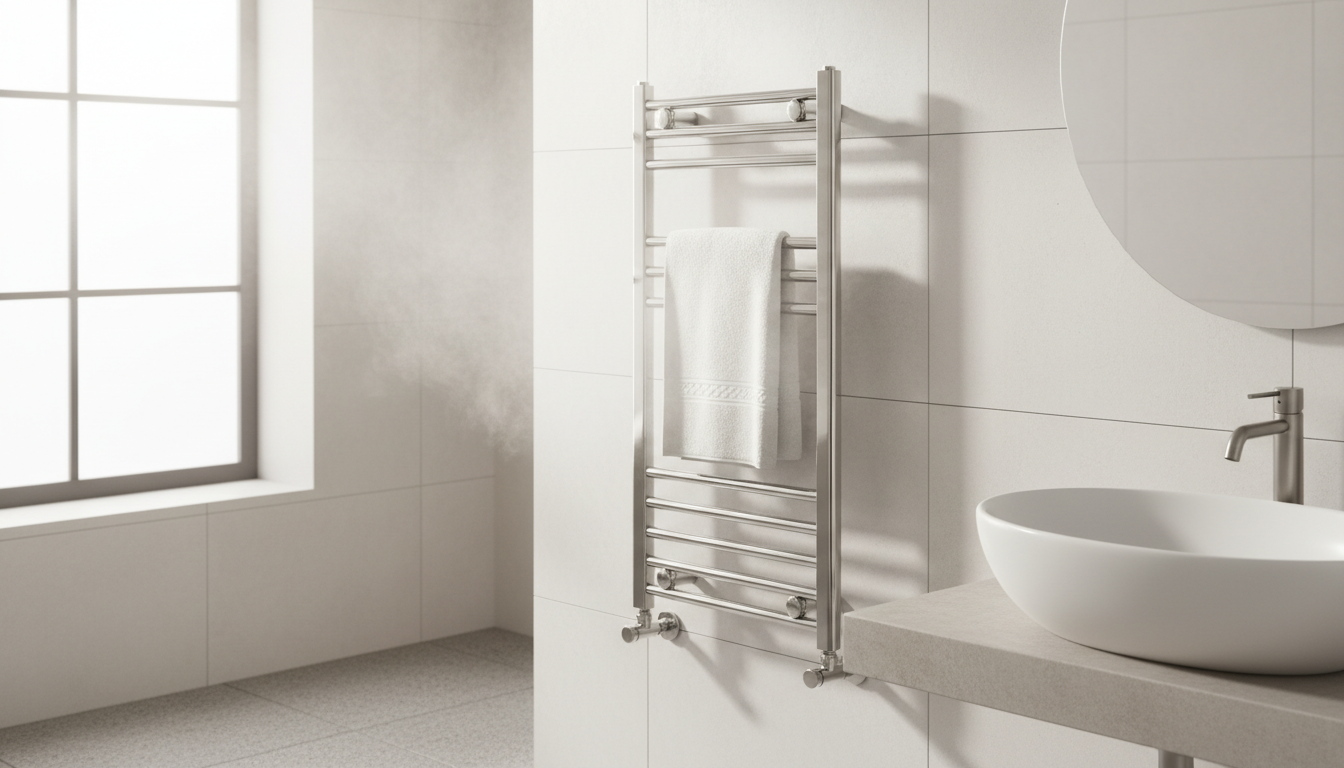
From small en-suites to spacious master bathrooms, we’ll uncover exactly when a heated towel rail can pull double duty as your primary heat source and when you might need additional heating solutions.
Can Heated Towel Rails Heat Your Bathroom? The Short Answer
Yes, heated towel rails can heat your bathroom, but with important conditions. Their effectiveness depends on your bathroom size, insulation quality, the rail’s heat output (measured in BTUs), and whether you have towels hanging on the rail.
Quick Facts: A heated towel rail works best as the primary heat source in small, well-insulated bathrooms under 5m². For medium to large bathrooms, it typically needs to be paired with another heating source unless you choose a high-output model specifically designed for room heating.
Understanding Heat Output: The BTU Factor
Before deciding if a towel rail can heat your bathroom, you need to understand BTUs (British Thermal Units). This measurement tells you how much heat your bathroom needs and how much heat a towel rail provides.
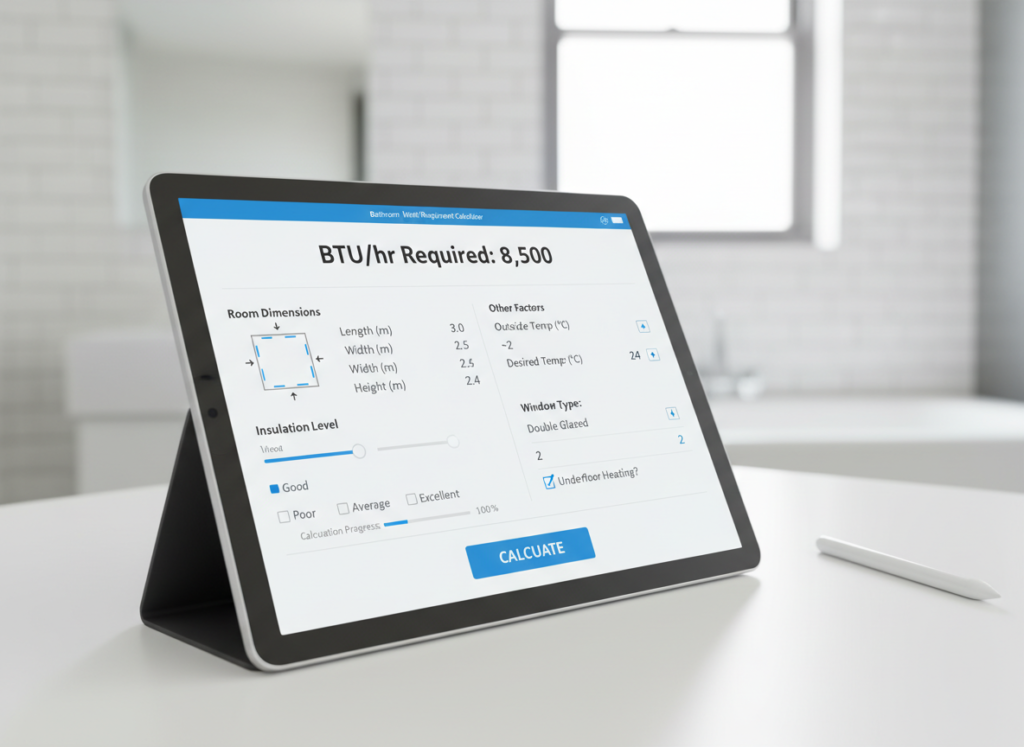
How to Calculate Your Bathroom’s BTU Requirement
Your bathroom’s heating needs depend on several factors:
- Room dimensions (length, width, height)
- Number of external walls
- Window size and glazing type
- Insulation quality
- Floor level (ground floors need more heat)
For a quick estimate: a small bathroom (4m²) typically needs 2,000-3,000 BTUs, while a medium bathroom (6-8m²) requires 3,000-5,000 BTUs. Large bathrooms (10m²+) often need 5,000+ BTUs.
Most standard heated towel rails provide between 1,000-3,000 BTUs, though high-output models can reach 5,000+ BTUs. Always check the product specifications for the exact BTU rating.
Types of Heated Towel Rails and Their Heating Capacity
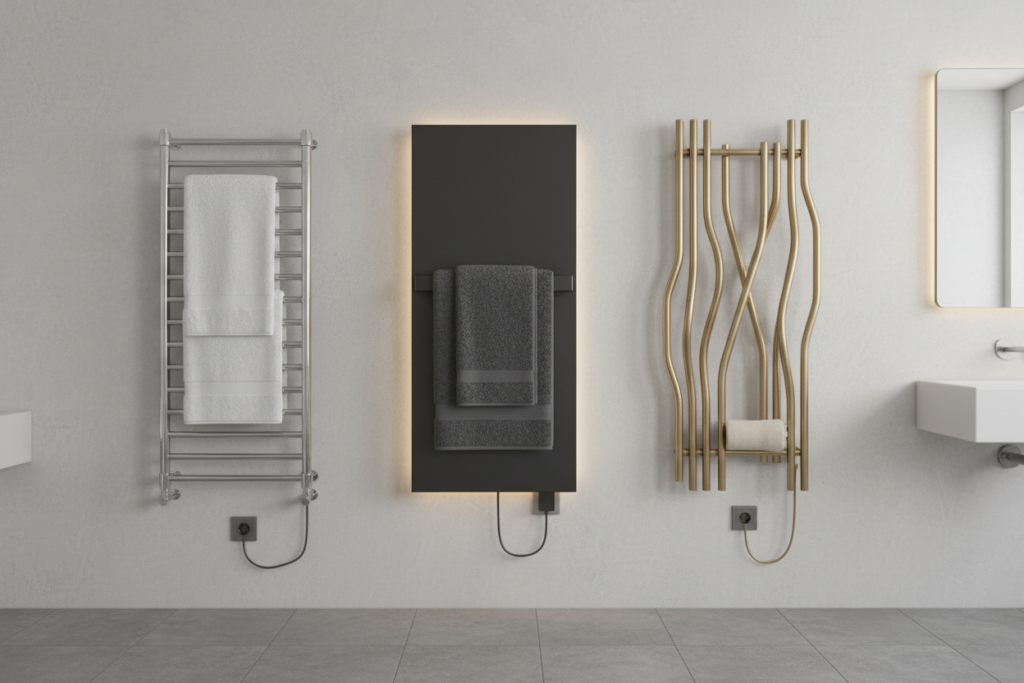
Not all heated towel rails are created equal when it comes to heating your bathroom. The type you choose significantly impacts its heating performance.
| Towel Rail Type | Heat Output Range | Best For | Room Heating Capability |
| Standard Ladder Rail | 1,000-2,500 BTUs | Small bathrooms, en-suites | Limited – primarily for towel warming |
| High-Output Ladder Rail | 3,000-5,000 BTUs | Medium bathrooms | Good for small to medium spaces |
| Panel Towel Radiator | 4,000-7,000 BTUs | Medium to large bathrooms | Excellent – designed for room heating |
| Traditional Column with Towel Bar | 3,500-6,000 BTUs | Period properties, larger bathrooms | Very good – balances aesthetics and heat |
| Electric Towel Rail | 1,000-3,000 BTUs | Supplementary heating, towel warming | Limited unless high-wattage model |
Material Matters: Which Conducts Heat Best?
The material of your towel rail affects its heating efficiency:
Stainless Steel
Heats up quickly but cools faster when the heating system turns off. Good for responsive heating but less heat retention.
Aluminum
Excellent conductor that heats up rapidly and uses less energy. Ideal for electric models and energy efficiency.
Brass
Provides steady, consistent heat with excellent retention. Premium option that maintains warmth longer.
Chrome-Plated
Popular for looks but reduces heat output by about 20% compared to non-plated models. Style over performance.
Bathroom Size: The Deciding Factor
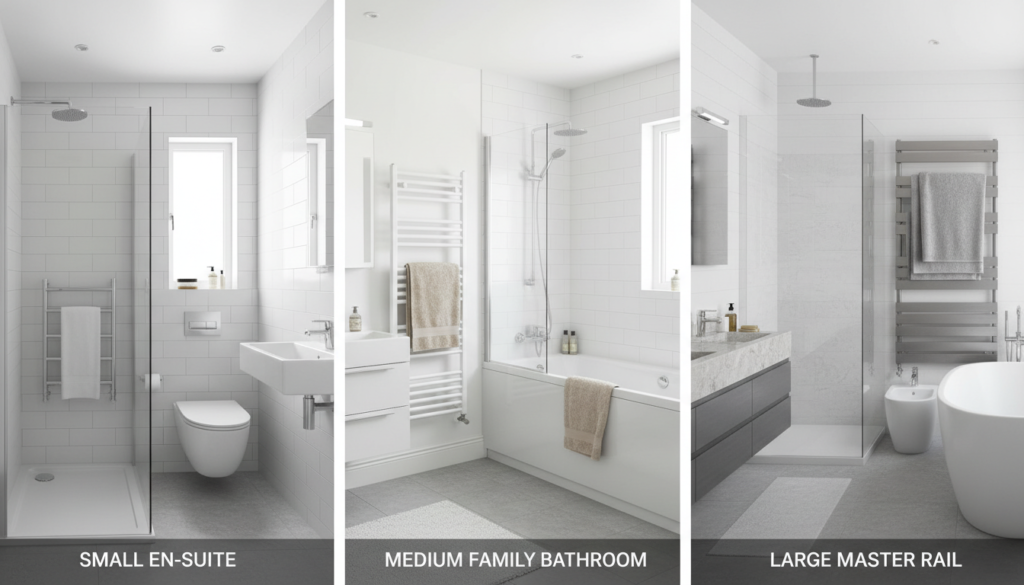
The size of your bathroom is perhaps the most critical factor in determining whether a heated towel rail can serve as your primary heat source.
Small Bathrooms and En-Suites (Under 5m²)
Good news for small bathroom owners! A quality heated towel rail can often provide sufficient heat for these compact spaces. Small bathrooms retain heat well, and with limited air volume to warm, even a standard towel rail with 2,000-3,000 BTUs can maintain comfortable temperatures.
My en-suite is just 4m² and my 2,500 BTU chrome towel rail keeps it perfectly warm, even in winter. I was surprised at how effective it is in such a small space.
Medium Bathrooms (5-9m²)
For medium-sized bathrooms, a standard towel rail might struggle as the sole heat source, especially in colder regions. Consider these options:
- Choose a high-output towel rail (4,000+ BTUs)
- Install a panel-style towel radiator with greater surface area
- Pair a standard towel rail with underfloor heating
Large Bathrooms (10m²+)
Large bathrooms typically need more than just a towel rail for adequate heating. The most effective approach is a dual heating system:
Option 1: Dual Fixtures
Install both a heated towel rail for towels and a separate radiator for room heating. This provides optimal functionality without compromising on either purpose.
Option 2: High-Output Designer Radiator
Choose a designer radiator with integrated towel bars that delivers 6,000+ BTUs. These hybrid fixtures offer both high heat output and towel warming capabilities.
Factors That Affect Heating Efficiency
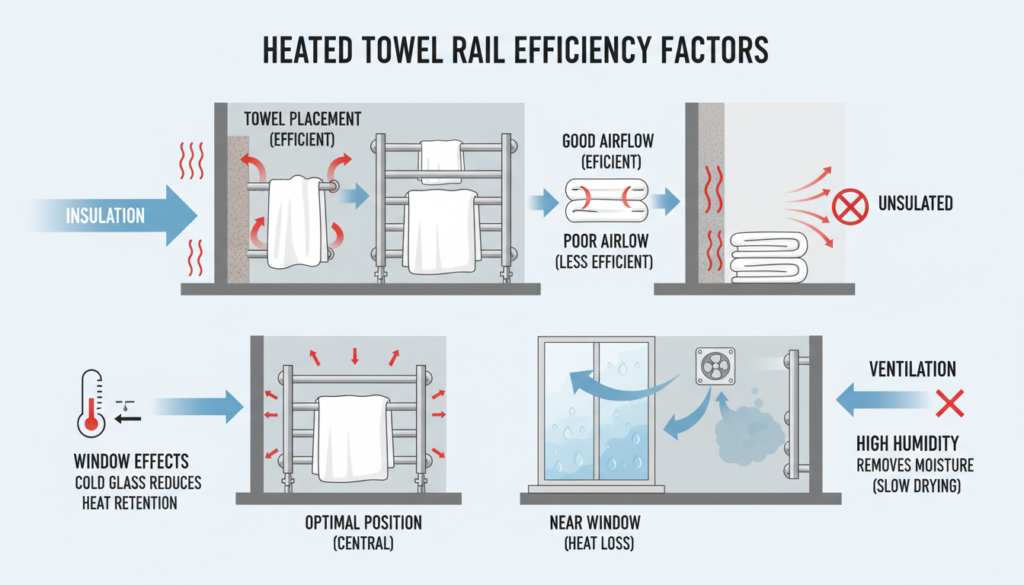
Several factors influence how effectively a heated towel rail can warm your bathroom:
Towel Coverage
When you hang towels on your rail, they absorb some of the heat that would otherwise warm the room. More towels mean less heat reaches the bathroom air. For maximum room heating, limit towel coverage to 50% of the rail surface.
Bathroom Insulation
Well-insulated bathrooms retain heat much better than poorly insulated ones. Check for these common heat-loss culprits:
- Single-glazed windows
- Gaps around doors and windows
- Uninsulated external walls
- Cold bridges in construction
Rail Placement
The position of your towel rail affects its heating efficiency. For optimal room heating:
Best Placements
- Opposite the bathroom door
- Under windows to counter cold drafts
- On external walls to balance heat loss
Poor Placements
- Behind doors where air circulation is blocked
- In corners with limited air flow
- Too close to shower enclosures where moisture is high
Ventilation Balance
Bathrooms need ventilation to manage moisture, but excessive ventilation removes warm air. Use timer-controlled extraction fans that run only when needed rather than constant ventilation.
Electric vs. Central Heating Towel Rails: Which Heats Better?
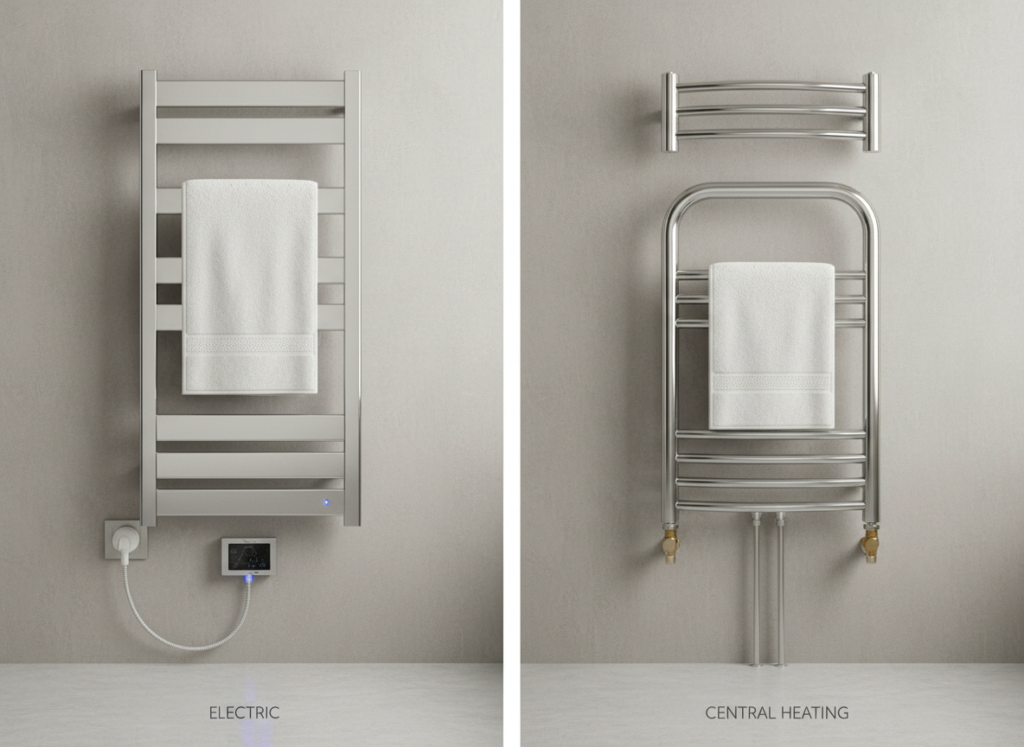
The heating system powering your towel rail significantly impacts its performance as a room heater.
| Feature | Central Heating Towel Rails | Electric Towel Rails |
| Heat Output Control | Tied to central heating system | Independent temperature control |
| Year-Round Use | Limited to when heating system is on | Can be used any time, regardless of season |
| Heat-Up Time | Slower (15-30 minutes) | Faster (5-15 minutes) |
| Energy Efficiency | More efficient if boiler is already running | More efficient for short, targeted heating |
| Room Heating Capability | Generally higher BTU output | Varies by wattage (40-600W models available) |
Dual Fuel: The Best of Both Worlds
Dual fuel towel rails connect to both your central heating and electrical systems, offering flexibility:
- Use central heating mode during winter when the system is running
- Switch to electric mode in summer or when central heating is off
- Enjoy warm towels and bathroom heating year-round
For maximum room heating capability, look for electric towel rails with at least 400W power output or central heating models with 3,000+ BTU ratings.
Real-World Scenarios: When Towel Rails Can Heat Your Bathroom
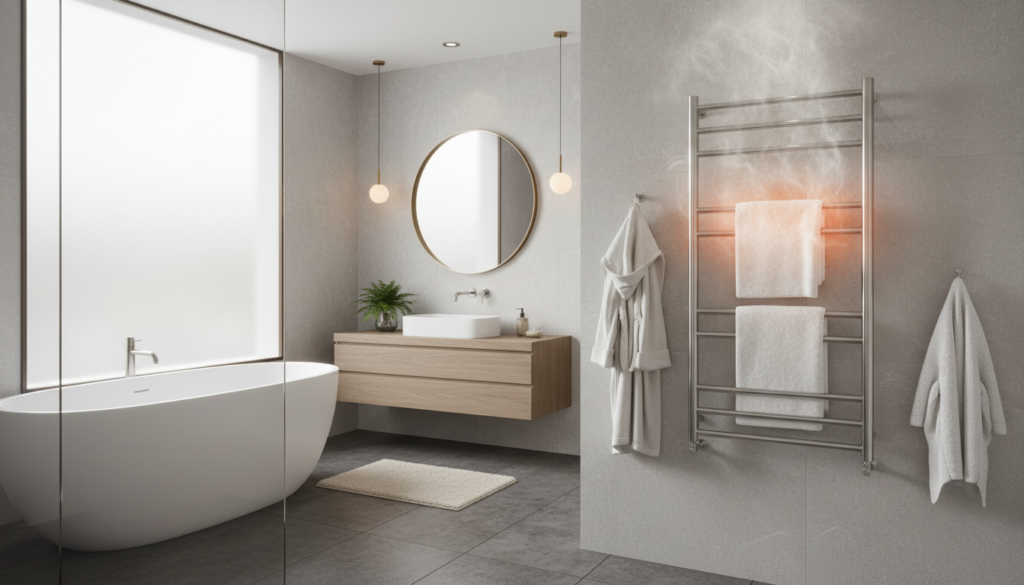
Let’s explore some common bathroom scenarios to determine when a heated towel rail can effectively serve as your primary heat source.
Scenario 1: Small En-Suite (3-4m²)
Can a towel rail heat it? Yes, most definitely.
A standard heated towel rail with 2,000+ BTUs will adequately heat this space. The small air volume and typically good insulation (as en-suites are often internal rooms) mean heat builds up quickly and stays contained.
Recommendation: A ladder-style rail with 2,000-3,000 BTUs will provide sufficient heat while keeping towels warm and dry.
Scenario 2: Family Bathroom (6-8m²)
Can a towel rail heat it? Yes, with conditions.
A standard towel rail might struggle, especially in winter or in poorly insulated spaces. You’ll need either a high-output model or a supplementary heat source.
Recommendation: Choose a high-output towel radiator (4,000+ BTUs) or combine a standard rail with underfloor heating for optimal comfort.
Scenario 3: Large Master Bathroom (10m²+)
Can a towel rail heat it? Unlikely on its own.
Large bathrooms have too much air volume for most towel rails to heat effectively. The heat dissipates before reaching comfortable levels throughout the space.
Recommendation: Install a towel rail for towel warming and a separate radiator for room heating, or choose a designer radiator with integrated towel bars that delivers 6,000+ BTUs.
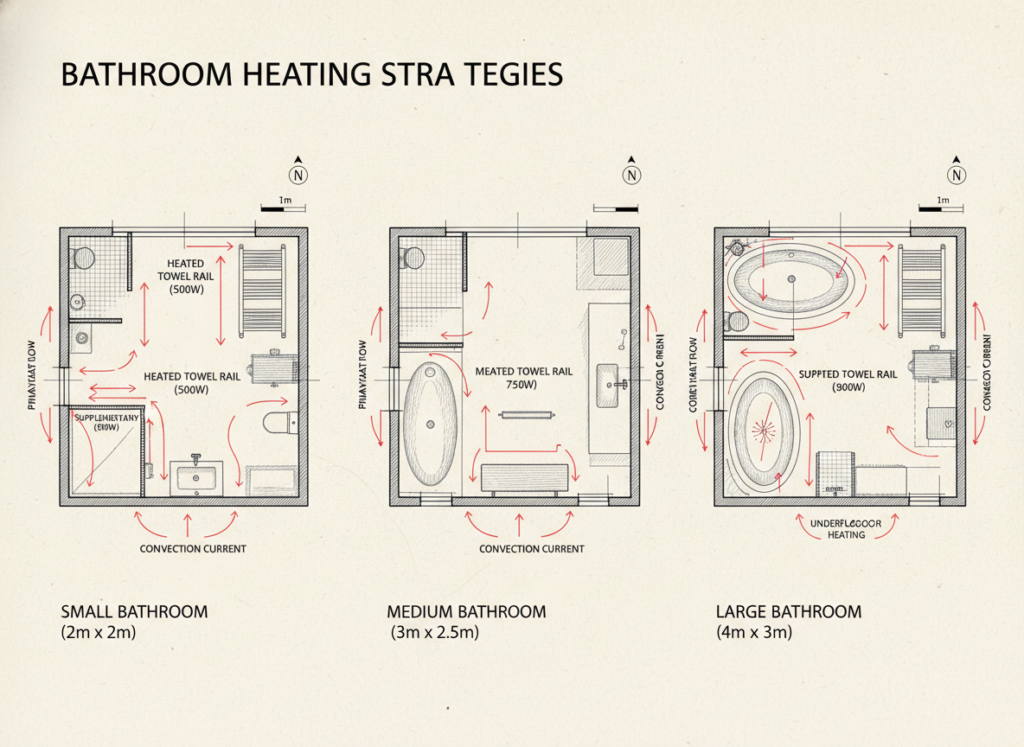
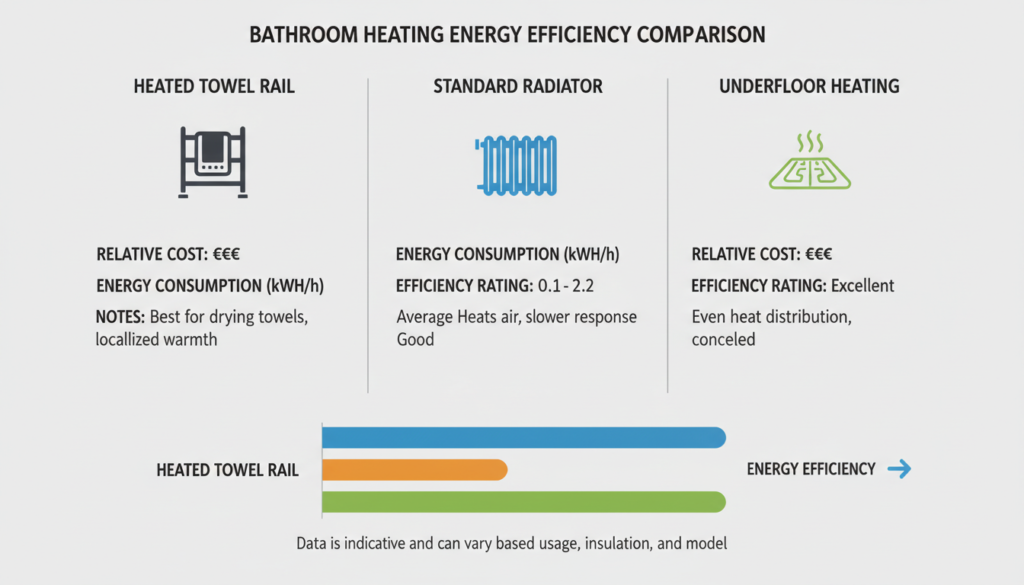
Energy Efficiency and Running Costs
Understanding the energy consumption and running costs of heated towel rails helps you make an informed decision about using them as room heaters.
Running Cost Comparison
The table below shows approximate running costs for different heating options based on average UK energy prices:
| Heating Type | Average Power | Cost Per Hour | Cost Per Month (3hrs/day) |
| Standard Electric Towel Rail | 150W | 5p | £4.50 |
| High-Output Electric Towel Rail | 400W | 13p | £12.00 |
| Central Heating Towel Rail | N/A | Part of central heating | Minimal additional cost |
| Standard Bathroom Radiator | N/A | Part of central heating | Minimal additional cost |
| Electric Underfloor Heating (4m²) | 600W | 20p | £18.00 |
Energy-Saving Tips
Maximize efficiency when using a heated towel rail as a room heater:
- Use a timer to run the rail only when the bathroom is in use
- Install a thermostatic valve to maintain optimal temperature
- Keep doors closed to contain heat within the bathroom
- Consider dual fuel models for seasonal flexibility
- Limit towel coverage to 50% of the rail for maximum room heating
Leaving electric towel rails running 24/7 is unnecessary and wastes energy. Most bathrooms only need heating for short periods before and during use.
Recommendations: Finding Your Perfect Heating Solution
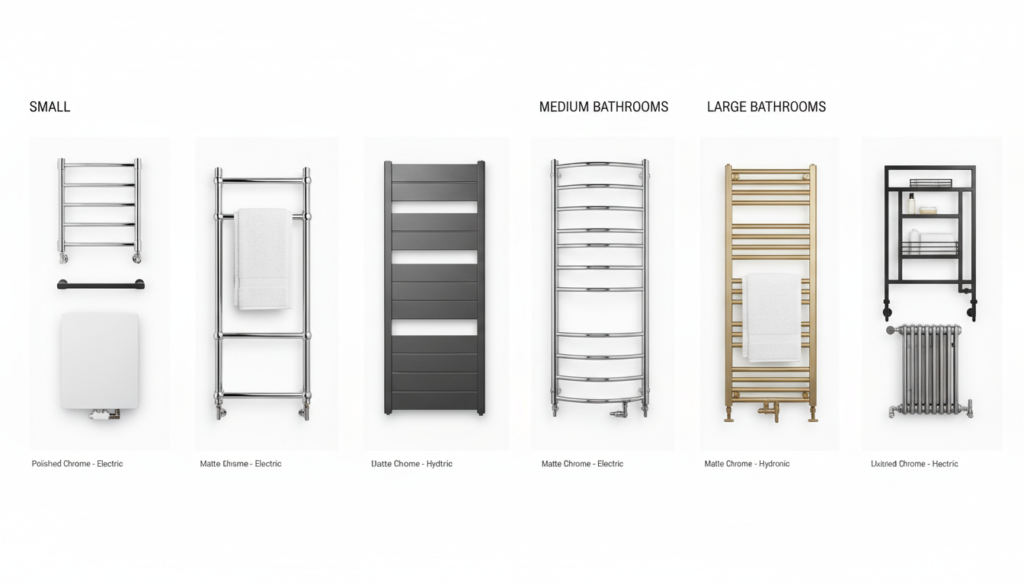
Based on our comprehensive analysis, here are our recommendations for different bathroom scenarios:
Small Bathrooms
Best Option: Standard ladder-style heated towel rail (2,000-3,000 BTUs)
A quality standard towel rail provides sufficient heat for small spaces while keeping towels warm and dry. Look for models with at least 7-8 bars for adequate towel hanging space.
Medium Bathrooms
Best Option: High-output towel radiator (4,000+ BTUs)
Choose a panel-style towel radiator or a wide ladder rail with high heat output. These provide enough warmth for medium spaces while maintaining style and functionality.
Large Bathrooms
Best Option: Dual system (towel rail + radiator)
For optimal comfort in large bathrooms, install both a heated towel rail for towels and a separate radiator for room heating, or choose a high-output designer radiator with towel bars.
Special Considerations
For Poorly Insulated Bathrooms
If your bathroom has poor insulation, single glazing, or many external walls, increase your BTU requirement by 15-20% above the standard calculation to ensure adequate heating.
For Infrequently Used Bathrooms
For guest bathrooms or spaces used infrequently, electric towel rails with timers offer the most efficient solution, providing heat only when needed.
Conclusion: Making the Right Choice for Your Bathroom
So, do heated towel rails heat the bathroom? The answer is yes, but with important qualifications. Their effectiveness depends on your bathroom size, insulation quality, the rail’s heat output, and how you use it.
For small bathrooms and en-suites, a quality heated towel rail can often provide all the heat you need. For medium and large bathrooms, you’ll likely need either a high-output model or additional heating sources to maintain comfortable temperatures.
Remember that the primary purpose of a heated towel rail is to warm and dry your towels. Their room heating capability is a beneficial secondary function that works best in smaller spaces. By understanding your bathroom’s specific needs and choosing the right product, you can enjoy both warm towels and a comfortable bathroom environment.
Find Your Perfect Heated Towel Rail Today
Browse our extensive collection of heated towel rails and bathroom radiators to find the perfect heating solution for your space. With options for every bathroom size and style preference, you’ll find exactly what you need.