
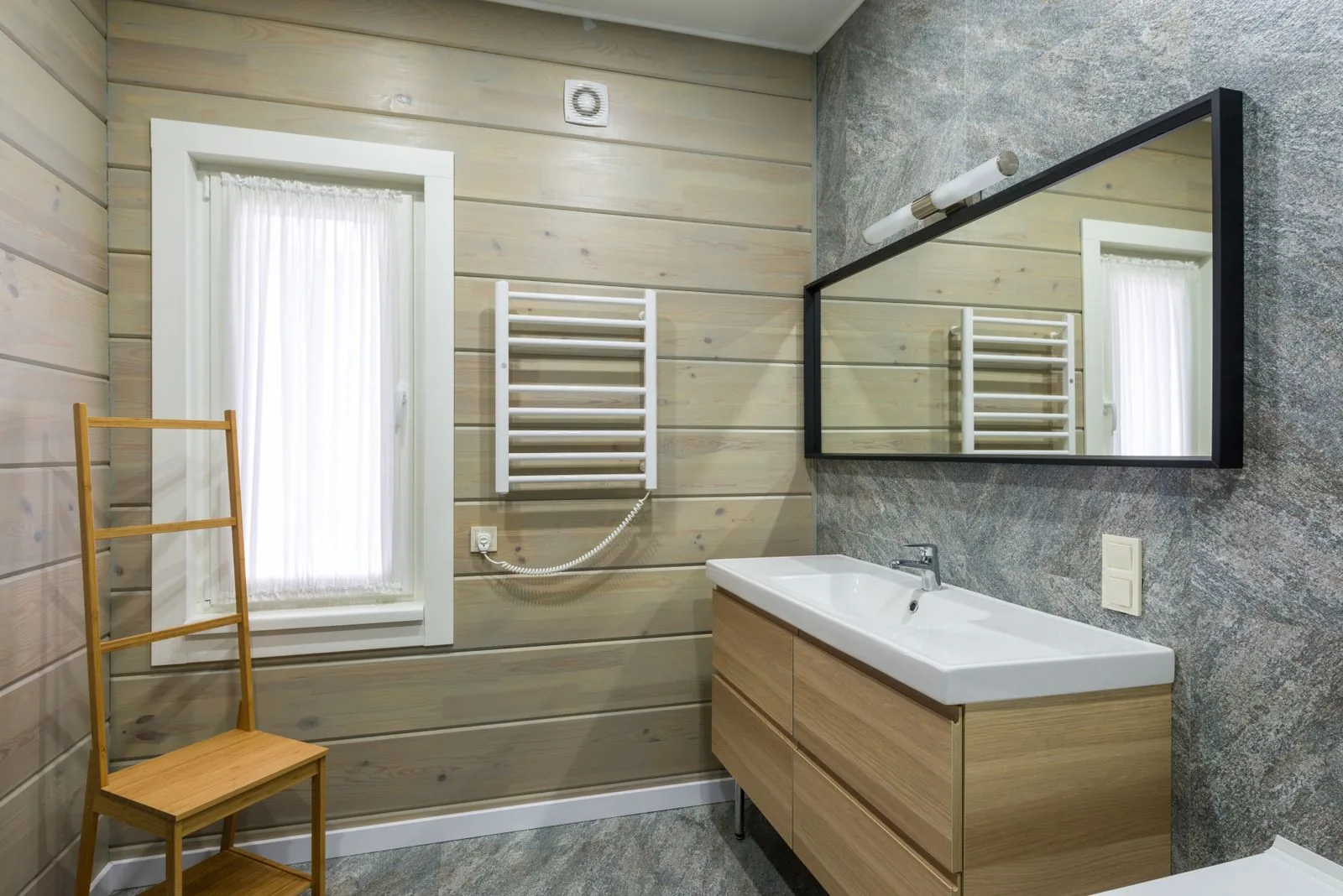
Short answer: a towel warmer is worth it if you want a warm towel every day or your bath towel never fully dries between showers, and the electricity is cheaper than most people expect. At the June 2026 US average rate, a 150 W wall rack run two hours a day costs about $20 a year. A towel warmer is not worth it if you expect it to dry laundry, or if you plan to leave a rack switched on around the clock without a timer, which can push the bill past $240 a year.
Below are the numbers for four real models, what each type can and can’t do according to its own manual or listing, and a quick rule for deciding.
We may earn a commission when you buy through links on this page, at no extra cost to you. As an Amazon Associate we earn from qualifying purchases.
How we worked this out
We didn’t test these warmers. We took each model’s rated wattage from the manufacturer’s listing or a retailer spec sheet and multiplied it by realistic daily run times. The price per kilowatt-hour is 18.34 cents, the US residential average for June 2026 in the EIA’s Monthly Energy Review (Table 9.8). Your own rate may be lower or much higher; EIA’s August 2026 figures range from 8.91 cents in North Dakota to 29.02 cents in California.
The formula is simple: watts / 1,000 x hours per day x 365 x your rate. Rated wattage is the maximum draw. Units with a thermostat or overheat cut-off cycle the element, so real use is usually at or below these figures, never above.
Yearly running cost: 4 models compared
| Model | Type | Rated watts | Typical use | Cost per year* | Left on 24/7* |
|---|---|---|---|---|---|
| LiveFine Large Bucket | Bucket, plug-in | 480 W max | 30 min/day | $16.07 | Not possible (60-min timer) |
| Keenray CL1Plus | Bucket, plug-in | 450 W | 30 min/day | $15.06 | Not possible (auto shut-off) |
| Amba Radiant RWH-SP | Wall rack, plug-in or hardwired | 150 W | 2 h/day | $20.08 | up to $240.99 |
| HEATGENE 10-Bar | Wall rack, plug-in or hardwired | 220 W | 2 h/day | $29.45 | up to $353.45 |
*At 18.34 cents/kWh (EIA, June 2026), using rated wattage as the ceiling. Bucket figures use one 30-minute cycle per day; a full 60-minute cycle doubles them (LiveFine $32.13, Keenray $30.12).
Two things stand out. First, a bucket draws three times the power of a rack but runs for a fraction of the time, so the yearly cost lands in the same range. Second, the real cost risk is a rack with no timer that stays on all day. That is where a $20 habit turns into a $240 one.
What towel warmers do well, and what they don’t
Warming a dry towel: yes, quickly
Consumer Reports measured seven bucket and rack warmers in 2026. Bath towels from all the buckets felt warm after about 15 minutes; towels on the two racks took about 25 minutes. So both types work, and buckets are faster.
Drying a wet towel: racks only, and slowly
This is the most common misunderstanding. Bucket warmers are sealed containers, and LiveFine’s own user guide says plainly: “Do not use the towel warmer to dry wet items.” It also warns that damp towels greatly extend the heating cycle. A rack is open to the room air, so a towel hung on it after one use will dry between showers. A soaking-wet towel straight from the washer is a different job; Good Housekeeping notes a rack doesn’t produce enough heat to dry that quickly, and a dryer or line is the better tool.
Heating the bathroom: no
At 150 to 220 W, a rack puts out roughly what two or three old incandescent bulbs did. It takes the chill off the towel, not the room.
The burn risk is real
Consumer Reports recorded inside surfaces up to 274°F and outside surfaces up to 158°F on some bucket warmers, and its tester burned his hand reaching into one. The two racks it measured passed 170°F and had no auto shut-off. If you have small children or someone with limited mobility in the house, a bucket with a lid and timer is easier to manage than an always-hot rack at grab height.
The 4 models, and who each suits
1. LiveFine Large Bucket Towel Warmer: best if you want the hottest towel with zero install
LiveFine’s large bucket is a plug-in unit with a four-step timer (15, 30, 45 or 60 minutes) and automatic shut-off. Per the listing it fits two 40 x 70 in bath sheets and keeps the towel warm for up to 20 minutes after the cycle ends. It carries 4.3/5 from 2,877 Amazon ratings (Best Sellers page, checked November 2026).
Who it’s for: renters, anyone who can’t drill into tile, and people who mainly want the warm-towel moment.
Who should skip it: anyone whose real problem is a towel that stays damp. The manual rules out wet items.
- Pro: no installation; it plugs into a standard 120 V outlet
- Pro: timer caps every session, so it can’t run all day by accident
- Pro: fits two oversized bath sheets per the maker
- Con: 60 minutes is the longest setting, so it can’t be pre-scheduled hours ahead
- Con: LiveFine’s site lists 18 L capacity while the user guide says 19 L, a small but real inconsistency
- Con: takes counter or floor space, which small bathrooms don’t have
2. Keenray CL1Plus: best bucket if you want a delay timer and heat settings
The CL1Plus is a 20 L, 450 W bucket with more control than most. Keenray’s product copy lists heating times of 15, 30, 45 or 60 minutes, a delay timer of up to 24 hours, three temperature settings (167, 176 or 185°F) and a real-time temperature check. It has 4.6/5 from 885 Amazon ratings (November 2026).
Who it’s for: people who want the towel ready at the same time every morning without pressing a button first.
Who should skip it: households with small children, given how hot buckets get inside, unless it sits out of reach.
- Pro: delay timer means the 30-minute cycle can finish right as you step out
- Pro: lowest yearly cost in our table at 30 minutes a day ($15.06)
- Pro: stainless steel liner per the maker
- Con: the highest heat setting is 185°F, so handle the towel with care
- Con: like every bucket, it is for dry towels only
3. Amba Radiant RWH-SP: best low-wattage rack for drying towels between uses
Amba’s Radiant straight rack has 10 bars, measures about 23.75 in wide by 31.5 in high, and is rated 150 W at 1.3 amps on 120 V (Build.com spec sheet). It ships as a plug-in unit with a hardwire conversion kit and an on/off switch; timers are optional extras. It has 4.1/5 from 105 Amazon ratings (November 2026).
Who it’s for: anyone whose towel goes musty by midweek, and people renovating who want a permanent fixture.
Who should skip it: anyone who won’t add a timer and tends to forget switches. Left on 24/7, it could cost up to $241 a year.
- Pro: lowest wattage of the four, so two hours a day costs about $20 a year
- Pro: plug-in out of the box, hardwire later if you want a cleaner look
- Pro: open bars dry a used towel, which buckets can’t do
- Con: no built-in timer; you buy one separately or use a plug-in timer
- Con: ratings vary across Amba’s Radiant variants on Amazon (the curved RWH-CB sits at 3.2/5 from 272 ratings), so check the exact model’s reviews
- Con: slower than a bucket to make a towel feel hot
4. HEATGENE 10-Bar Wall-Mounted: best rack for a family’s worth of towels
This HEATGENE rack is 304 stainless steel, ETL certified, with overheat protection and a choice of plug-in or hardwired wiring. The listing rates it at 220 W, reaching 110°F in 15 minutes and 130°F in 30 minutes at a 68°F room temperature, then holding that temperature. It has a 2-year manufacturer’s warranty and 4.2/5 from 360 Amazon ratings (November 2026).
Who it’s for: a shared bathroom where two people hang towels at once.
Who should skip it: anyone chasing the lowest running cost; the Amba does the same job on less power.
- Pro: holds at about 130°F, warm but below the bucket temperatures CR measured
- Pro: ETL listing and overheat protection stated on the listing
- Pro: three finishes (matte black, brushed, mirror polish)
- Con: wattage claims differ across HEATGENE’s own listings (220 W here, 150 W and 140 W on other 10- and 12-bar models), so the real draw is uncertain
- Con: no timer mentioned on the listing
- Con: highest yearly cost in the table if left on all day
So, is a towel warmer worth it for you?
Work through these in order and stop at the first one that fits.
- Your towel never dries between showers. Yes, buy a rack, not a bucket. A 150 W rack on a two-hour timer costs about $20 a year and fixes the musty-towel cycle. See our plug-in heated towel racks if you can’t hardwire.
- You just want a hot towel after a shower. Yes, and a bucket does it fastest. Expect roughly $15 to $16 a year at 30 minutes a day. Our bucket towel warmer picks cover more options.
- You want to dry laundry. No. Neither type is built for a load straight out of the washer.
- You live where power costs 30 cents or more per kWh. Still yes, with a timer. Multiply the table figures by your rate divided by 18.34; the Amba at two hours a day comes to about $33 a year at 30 cents.
- You won’t use a timer on a rack. Then budget for the 24/7 column, or choose a bucket that shuts itself off. Our list of towel warmers with timers takes this decision away.
For hardwired racks, the safe route is an electrician, and corded units belong on a GFCI outlet, which Good Housekeeping points out is required in bathrooms. Our guide to using a towel warmer covers placement and daily use.
FAQ
Do towel warmers use a lot of electricity?
No, if they run on a timer. The four models above cost between $15 and $30 a year at typical use and the June 2026 US average rate. A rack left on all day is the exception: up to $241 a year for a 150 W unit.
Can you leave a towel warmer on all the time?
Most buckets can’t be, because they shut off after 60 minutes. Racks can, but the two racks Consumer Reports measured had no auto shut-off and exceeded 170°F, so a timer is the safer and cheaper choice.
Do towel warmers dry wet towels?
Racks dry a used, damp towel over a couple of hours because air moves through the bars. Buckets don’t; LiveFine’s manual says not to put wet items in at all.
Is a bucket or a rack better?
A bucket makes a towel hotter faster (about 15 minutes versus 25 in Consumer Reports’ measurements) and needs no install. A rack dries towels between uses and frees up floor space. Pick by which problem you have.
Do towel warmers kill bacteria?
Not by heat alone at typical temperatures, according to the expert quoted by Yahoo Shopping. Drying the towel faster does slow bacterial growth and the musty smell that comes with it.
Sources
Checked November 3, 2026.
- EIA Monthly Energy Review, Table 9.8, average residential electricity price June 2026 (18.34 cents/kWh): eia.gov
- EIA Electricity Monthly Update, August 2026 state prices: eia.gov
- Consumer Reports, towel warmer temperature and warm-up measurements: consumerreports.org
- Good Housekeeping, GFCI and drying notes: goodhousekeeping.com
- Yahoo Shopping, expert comments on bacteria: shopping.yahoo.com
- LiveFine official site (18 L, 480 W max, timer settings): livefinetowelwarmer.com; LiveFine LFHTTWL01 user guide (19 L, 480 W, no wet items): manuals.plus
- Keenray CL1Plus product copy (timer, delay, heat settings): macys.com; 450 W per Keenray listing comparison: cadiens.com
- Amba Radiant RWH specs (150 W, 1.3 A, plug-in with hardwire kit): build.com, onlytowelwarmers.com
- HEATGENE 10-Bar specs and rating: Amazon listing ASIN B07TQH5WBL; other HEATGENE wattage figures: Amazon India listing ASIN B07HR9L81Y
- Ratings: Amazon Best Sellers in Towel Warmers (LiveFine B08ZT2YYRS, Keenray B0DF22JXRD); Amazon listing ASIN B00B4UC29W (Amba RWH-SP); Amazon Amba brand page (RWH-CB)